
Oil and Gas Boiler Replacement in Marcellus and Marietta
An oil boiler leaving a masonry chimney has a defined piece of work attached to it, and it belongs on the quote rather than in the conversation.
Boiler Replacement quote in Marcellus
Share a few details so we can confirm coverage and arrange the right next step.
Would you rather talk it through? Call (315) 640-3590, answered 24/7.
$100 off your first job
Credited by us on your first booked job.
- One credit per customer per property, on your first booked job.
- Valid through December 31, 2026.
Mention this offer when you book. Full terms.
Fuel oil in Marcellus, and the chimney rule that follows it
Of 2,711 occupied housing units in the town of Marcellus, the American Community Survey 2020-2024 five-year estimates report 1,971 heated with utility gas, 72.7 percent, 151 with fuel oil or kerosene, 5.6 percent, 96 with bottled, tank or LP gas, 3.5 percent, 370 with electricity, 13.6 percent, and 28 with wood. The combined fuel oil and bottled gas share of 9.1 percent is the second highest in Onondaga County. Of the occupied units, 2,126, 78.4 percent, are owner occupied.
Source: US Census Bureau, American Community Survey 2020-2024 5-year estimates, tables B25040 House Heating Fuel and B25003 Tenure, Marcellus town, Onondaga County, New York, accessed 2026-09-14
The American Community Survey 2020-2024 five-year estimates put the median year structure built in Marcellus village at 1952, plus or minus 10 years, and in the town of Marcellus at 1963, plus or minus 5 years. 38.4 percent of the village's 1,031 housing units were built in 1939 or earlier and 31.8 percent of the town's 2,789.
Source: US Census Bureau, American Community Survey 2020-2024 5-year estimates, tables B25034 and B25035, Marcellus town and Marcellus village, Onondaga County, New York, accessed 2026-09-14
The Town of Marcellus codes office states that under Town of Marcellus Local Law No. 3 of 2007 a building permit is required for work that must conform to the Uniform Code or the Energy Code, including the construction, enlargement, alteration, improvement, removal, relocation or demolition of any building or structure. Its published project list names furnace installation and fireplaces and alternative fuel heating devices, and it publishes a Heating Appliance Chimney Permit Application. The Town Hall is at 22 East Main Street, Marcellus, NY 13108, telephone 315-673-3269, open 8:30 AM to 4:00 PM Monday to Friday.
Source: Town of Marcellus, New York, Codes Office, Building Projects, accessed 2026-09-14
Section M1801.3 of the Residential Code of New York State applies where an appliance is permanently disconnected from an existing chimney or vent, or connected to an existing chimney or vent during a new installation. M1801.3.1 requires the chimney or vent to be resized as necessary to control flue gas condensation in its interior and to provide the appliance or appliances served with the required draft, with resizing for oil-fired appliances vented to masonry chimneys done in accordance with NFPA 31. M1801.3.2 requires the flue gas passageway to be free of obstructions and combustible deposits, to be cleaned if previously used for a solid or liquid fuel-burning appliance or fireplace, and the flue liner or inner wall to comply. M1801.3.3 requires a cleanout opening in masonry chimneys and M1801.3.4 sets clearance to combustibles.
Source: Residential Code of New York State, sections M1801.3 through M1801.3.4, Existing chimneys and vents, via UpCodes, accessed 2026-09-14
Oil fired boilers, masonry chimneys and what the code names
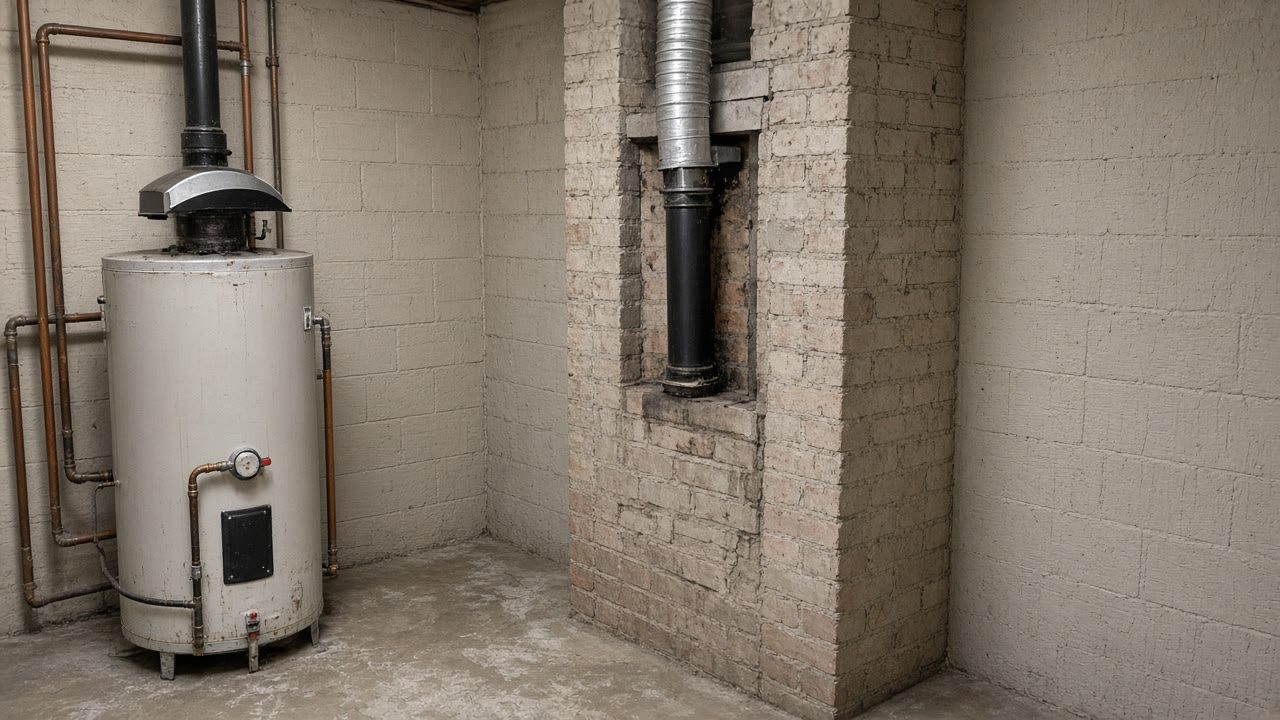
Marcellus records 151 occupied homes on fuel oil or kerosene and 96 on bottled, tank or LP gas, alongside 1,971 on utility gas, so oil fired boilers are a real population here rather than a rarity. That matters at the chimney. Section M1801.3 of the Residential Code of New York State applies where an appliance is permanently disconnected from an existing chimney or connected to one during a new installation, requires it to be resized as necessary to control flue gas condensation and provide the required draft, and points resizing for oil fired appliances vented to masonry chimneys at NFPA 31 specifically. The town gives that work a permit application of its own.
What a Marcellus boiler replacement has to settle
The building is the other constraint. Marcellus village runs 38.4 percent of its units built in 1939 or earlier and the town 31.8 percent, which is housing where heating was frequently added rather than designed in, and where pipe runs, radiator positions and flue routes are all the result of somebody's decision in 1950. That is where a replacement quote has the most room to be wrong. The survey that fixes it is a walk past every radiator and run of baseboard before anybody opens a catalog, and a drawing of the near boiler piping rather than a description of it. Town Hall is at 22 East Main Street on 315-673-3269.
Oil to masonry has a named standard
New York's code points resizing for oil fired appliances vented to masonry chimneys at NFPA 31. Ask whether that work is inside the price.
The town prints a chimney application
Marcellus publishes a Heating Appliance Chimney Permit Application separately from its other forms, which is a useful prompt.
A third of the housing predates 1940
Heating added after the fact means awkward pipe and flue runs, which is where a quote most often turns out to be wrong.
Get the flue work named in the quote
Tell us what the boiler burns and where it vents and we will arrange people who price both.
Other work we arrange in Marcellus and Marcellus Falls
Boiler questions from around Marcellus
Is it worth converting from oil to gas?
Only if a main is actually at the street, which in this town is not a safe assumption: 9.1 percent of homes here run on delivered fuel. Where there is no main, the genuine comparison is between a new oil appliance and a cold climate heat pump with a stated backup, and both deserve a proper calculation rather than a rule of thumb.
What does resizing a chimney actually mean?
Usually a correctly sized liner for whatever is left on the flue. New York's code requires a chimney to be resized as necessary to control flue gas condensation in its interior and to provide the appliance or appliances served with the required draft, at the moment an appliance is disconnected from it or connected to it.
Oil, propane or the gas main
Send the Marcellus address and we will arrange a comparison that starts from what you actually burn.