
Syracuse and the surrounding Onondaga County area
Furnace, Boiler, AC and Heat Pump Installation in Syracuse
Know what to ask before anybody prices a new system, then talk to someone who will answer it. Two decisions settle whether a replacement performs: the size, which is supposed to come from a calculation of your house rather than the nameplate of the unit being carried out, and what happens to the chimney once the old furnace stops using it. Tell us what you have now and which town the house is in, and we will connect you with licensed, insured contractors who put both on paper before a number is agreed.
Request a Quote
Share a few details so we can confirm coverage and arrange the right next step.
Would you rather talk it through? Call (315) 640-3590, answered 24/7.
$100 off your first job
Credited by us on your first booked job.
- One credit per customer per property, on your first booked job.
- Valid through December 31, 2026.
Mention this offer when you book. Full terms.
Five systems, and what is already in the house usually picks one
Which system you are buying is decided less by preference than by what the house already runs. A ducted house is a furnace or a ducted heat pump. A house on radiators is a boiler decision, and that is common here: the Energy Information Administration puts 27.9 percent of Middle Atlantic homes on steam or hot water against 7.5 percent nationally. Adding cooling to one of those is a third job again, because the ductwork was never designed in. Start with the work that matches what you have.
Furnace Replacement and Installation
Put a new gas furnace in with the size worked out from your house and the venting work priced before you sign, not discovered when the crew is already in the basement.
Start here if the house is heated by warm air from vents and the furnace is at or near the end of its life.
About Furnace Replacement →Boiler Replacement and Hydronic Heating
Replace the boiler that feeds your radiators or baseboard, sized against the house and the rooms it actually has to heat.
Start here if your heat arrives through radiators or baseboard and the boiler is what needs replacing.
About Boiler Replacement →Central Air Conditioning Installation
Add central air to a Syracuse house, or replace the system you have, sized so that it runs long enough to take the humidity out rather than just dropping the temperature.
Start here if the house has ductwork and you want cooling, whether it has ever had any or not.
About Central Air Installation →Heat Pump Installation and Conversion
Find out what a heat pump would really do in your house on the coldest nights of a Syracuse winter, and what covers the load when it cannot.
Start here if you are weighing electric heating against what you burn now, or you want heating and cooling from one machine.
About Heat Pump Installation →Ductwork and Air Distribution
Get the air to the rooms that never get it: new ducts, corrected ducts, or ductless equipment where there is nowhere to run a duct at all.
Start here if a room never gets comfortable, or the house has no ducts and needs another way to move air.
About Ductwork →Not sure which one you need?
Describe what you are seeing and we will tell you what the job actually needs.
How a replacement gets decided
A new system is settled in three moves, and the price is the last of them. This is the order they come in, and what you get a say in at each one.
What the house needs, before anyone names a size
The starting point is what is there now: warm air or radiators, gas or oil or propane, and whether cooling is being added to a house that has never had it. That last one is its own project in this metro, because the normals give only 570 cooling degree days a year against 6,651 for heating, so cooling here is an addition to a heating house rather than the system the house was built around.
A load calculation, then a model number chosen from it
Section M1401.3 of the Residential Code of New York State has equipment selected under ACCA Manual S from a load calculated under ACCA Manual J. NYSERDA instructs contractors to run that calculation rather than match the size of the unit coming out, because the house may have been insulated or reglazed since and the outgoing unit was frequently oversized itself. Ask for the worksheet. It is one question and it sorts the field before anybody visits.
A quote that prices the work around the equipment
Every bid includes the box. The differences live in the rest of it: where the new vent runs, what happens to a water heater left on the old chimney, who pulls the separate HVAC trade permit, what the electrical connection and the thermostat cost, and who takes the old appliance away. Two quotes thousands apart are usually two different scopes rather than two different prices for the same work.
What makes this a local problem
Section M1401.3 of the Residential Code of New York State, Equipment and appliance sizing, states that heating and cooling equipment and appliances shall be sized in accordance with ACCA Manual S or other approved sizing methodologies based on building loads calculated in accordance with ACCA Manual J or other approved heating and cooling calculation methodologies. The section carries no New York amendment marker, so New York adopts the model text unchanged.
Source: Residential Code of New York State, section M1401.3 Equipment and appliance sizing, via UpCodes, accessed 2026-09-14
Section 27-54(a)(2) of the City of Syracuse Property Conservation Code states that the capability of the heating equipment to maintain the required indoor temperatures shall be based on an outside temperature of minus ten degrees Fahrenheit.
Source: City of Syracuse Property Conservation Code, section 27-54(a)(2), Heating, general requirements, 2020 compilation published by the City of Syracuse, accessed 2026-09-14
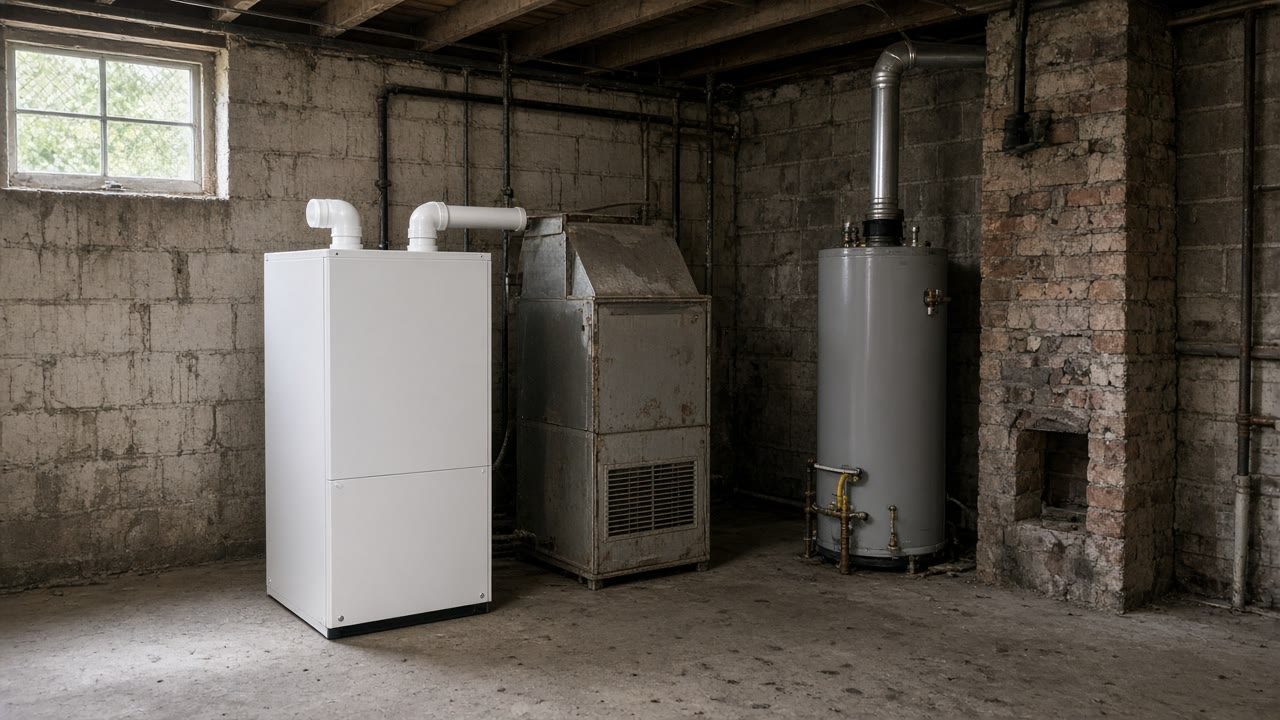
Oak Ridge National Laboratory states that in every upgrade of this kind the existing Category I noncondensing furnace is served by a negative static pressure vent, for example a clay tile lined masonry chimney or a Type B double-wall metal chimney terminating above the roof, and that this existing vent cannot be used by the Category IV condensing furnace directly. It describes the options as reusing the existing vertical vent as a chase for the new venting system, installing a new horizontal side-wall vent system where physical constraints and codes allow, or running a new vertical vent through the building, which it calls difficult and costly. It states that in all of these cases there are added costs compared with a like-for-like noncondensing furnace replacement.
Source: Oak Ridge National Laboratory, ORNL/TM-2014/624, section 2.3.1, October 2014, accessed 2026-09-14
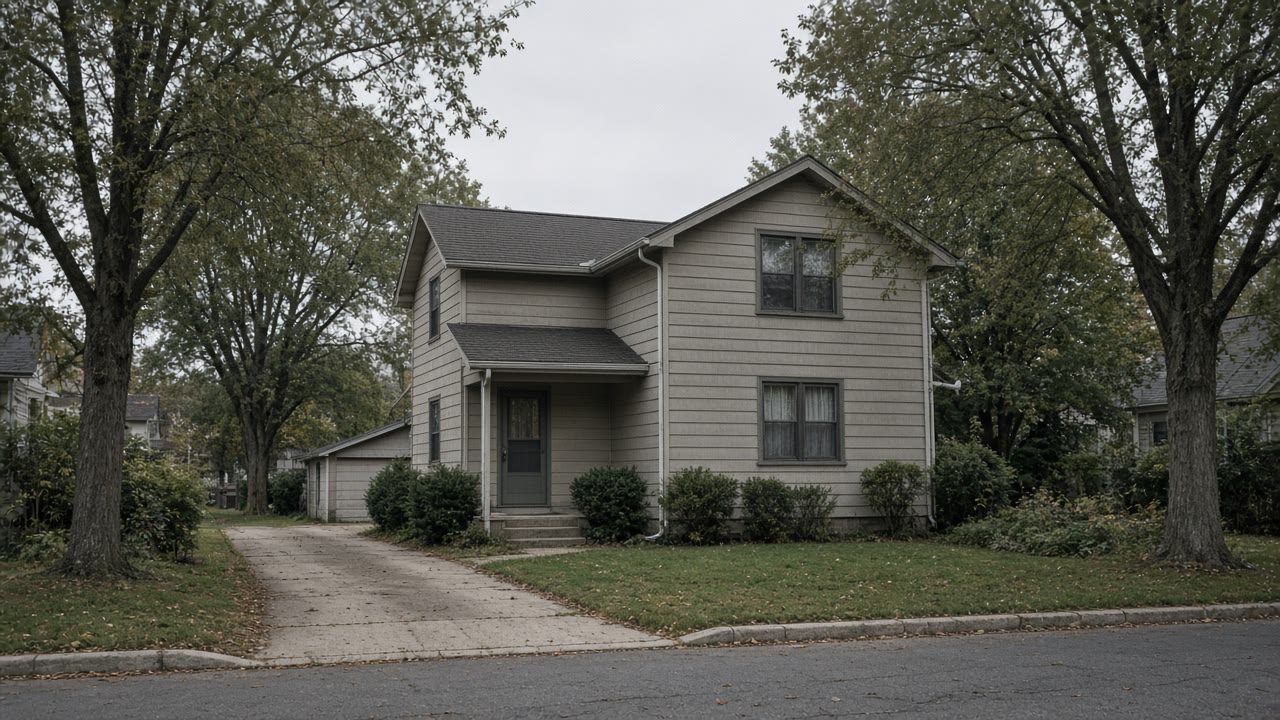
The American Community Survey 2020-2024 five-year estimates put the median year structure built in the city of Syracuse at 1948, with a margin of error of plus or minus 2 years. Of the city's 67,601 housing units, 29,152 were built in 1939 or earlier, which is 43.1 percent, 34,780 were built in 1949 or earlier, 51.4 percent, and 57,777 were built before 1980, 85.5 percent. Only 4,333 units, 6.4 percent, were built in 2000 or later. Of 59,816 occupied units, 24,889 are owner occupied, 41.6 percent.
Source: US Census Bureau, American Community Survey 2020-2024 5-year estimates, tables B25034, B25035 and B25003, Syracuse city, New York, accessed 2026-09-14
What happens to your chimney when the old furnace leaves it
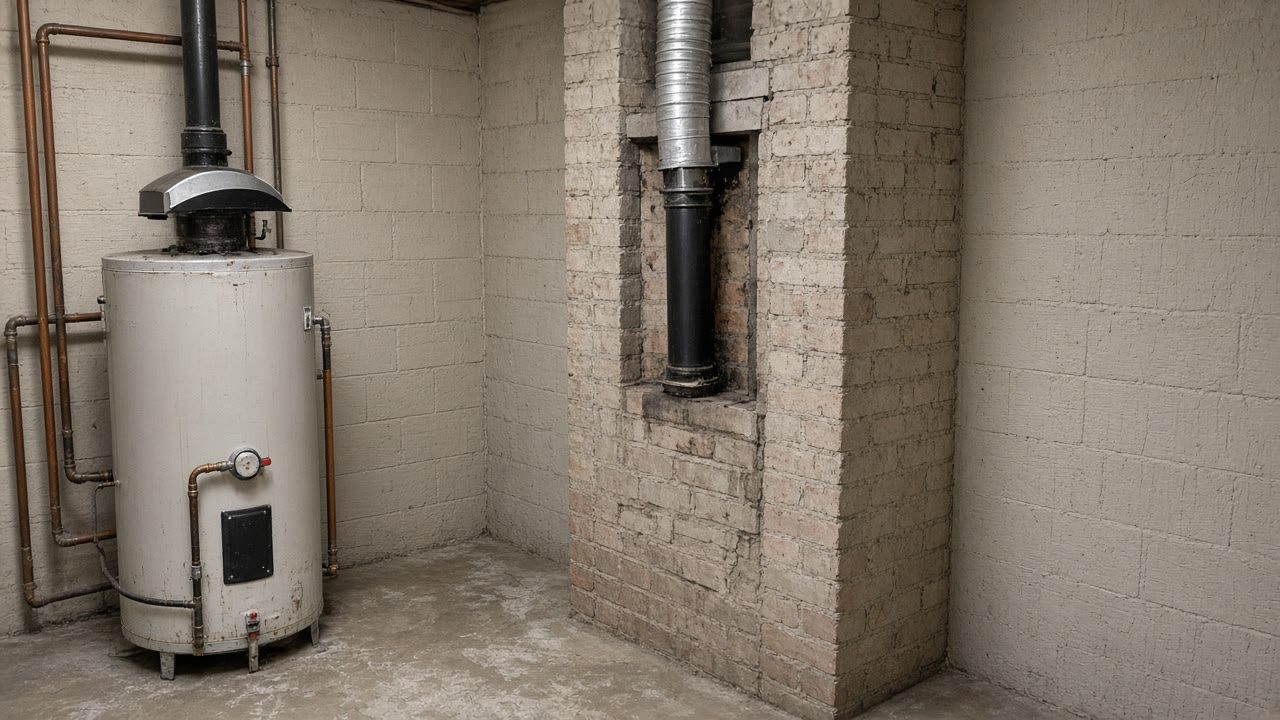
In a city where the median house was finished in 1948, a gas water heater very commonly shares one masonry chimney with the furnace. The furnace is the big appliance, and its exhaust is what keeps that flue warm enough to draw.
Put in a modern condensing furnace and it vents through a plastic pipe out the side wall instead. Oak Ridge National Laboratory uses the word orphaned for the water heater left behind: the flue was sized to carry two appliances and now carries one, so under some outdoor temperature and wind conditions there is not enough draft to take its exhaust up and out. Section M1801.3.1 of the Residential Code of New York State requires a chimney to be resized as necessary the moment an appliance is disconnected from it or connected to it.
The usual remedy is a liner sized for the single appliance that is left, and it is a real number on a real invoice. Whether it appears in the quote is the difference between a bid you can compare and a bid that grows. Ask what happens to the chimney and who is paying for it before you sign, rather than when the crew is already in the basement.
Why homeowners call us first
We raise the size question before anyone visits
The decision that determines whether a system performs is the one no install page in this metro mentions. New York's residential code has the size arrived at by calculation, and NYSERDA tells contractors in as many words to avoid rules of thumb and like-for-like replacement without their own calculation. We tell you to ask for the worksheet, and we tell the contractor you will be asking for it.
We tell you what a quote has to contain
Oak Ridge National Laboratory states plainly that a condensing furnace cannot use the vent the old furnace used and that building a new route costs more than a like-for-like swap. So two honest quotes can differ by thousands because one has priced the venting and one has not. Knowing the line items to look for is what turns three pieces of paper into a comparison.
We say out loud that the federal credit has ended
Section 25C of the Internal Revenue Code now states that it does not apply to property placed in service after December 31, 2025, and pages across this metro still advertise it as live. What remains is administered by the electric utility, National Grid for most of this county, under New York State Clean Heat. Have the contractor pull the current position for your utility zone before you sign, because a figure printed on a quote can be a program year out of date.
The permit here is separate, and it is local
The City of Syracuse Central Permit Office lists HVAC as a trade permit that has to be obtained separately from a residential construction permit, and across the ring towns the answer changes from town to town. New York issues no statewide heating and cooling license at all, so what can be checked at your address is whatever the local codes office holds. We tell you which office governs your street.
Coverage across Syracuse and the surrounding Onondaga County area
What buyers ask before they take three quotes
How is the size of a new system supposed to be decided?
By a calculation of your house, not by reading the old nameplate. Section M1401.3 of the Residential Code of New York State has heating and cooling equipment sized under ACCA Manual S from building loads calculated under ACCA Manual J. NYSERDA puts numbers on why it matters: impacts on energy use and comfort begin when a heat pump system is sized at 120 percent of the building load, and NYSERDA says severe impacts can begin above 150 percent. One question on the phone sorts the field. Will you do a load calculation for my house, and will you give me the worksheet?
My furnace is twelve years old and still working. Should I be replacing it?
Probably not, and this is not your conversation yet. The Energy Information Administration reports 31.1 percent of main heating equipment in this part of the country at twenty years or older, against 19.1 percent nationally, so an aging system here is ordinary rather than alarming. Age on its own is not a reason to replace anything. If it runs and the repairs are occasional, keep it, and start reading about the replacement a year before you expect to buy one. Anyone using age as the whole argument is selling.
A technician has told me my system is finished. Do I have to take that as settled?
No, and you are allowed to take your time. Diagnosing a fault and choosing what replaces it are two different jobs, and only the first of them is urgent. If the house is warm, get a second opinion on the fault before you collect three quotes on a new system. A fair number of calls here end with us saying that what you have is a repair question rather than a replacement one, and pointing you back at it.
The quote is for a bigger furnace than the one being taken out. Is bigger better?
No. A furnace that is too large satisfies the thermostat quickly, shuts off and starts again, which gives you uneven rooms and blasts of hot air instead of steady warmth, plus more starts on the ignition over the life of the appliance. On the cooling side it is worse. NYSERDA states that dehumidification requires the system to run for an extended period and that oversized systems have shorter run times and may fail to dehumidify the space, so the house ends up cold and clammy rather than cool and dry. If the proposed size is larger, ask which calculation produced it.
Is New York going to make me replace my gas furnace?
No. New York Energy Law section 11-104 directs a prohibition on fossil fuel combustion systems in NEW buildings not exceeding seven stories, and the statute then says expressly that the prohibition is not to be construed as applying to buildings existing before it takes effect, including their repair, alteration, addition and change of use, and including the installation and continued use of fossil fuel equipment in them. Nothing in it requires an existing Syracuse house to go electric when its furnace fails.
Will a heat pump get through a Syracuse winter?
The useful question is not whether it works, it is where the balance point sits and what covers the load beneath it. The Department of Energy defines the balance point as the outdoor temperature at which the heat pump's capacity matches what the house is losing; below that, something else makes up the difference. The Syracuse normals give about 7 nights a year at or below 0F and 57 at or below 20F, and section 27-54(a)(2) of the City of Syracuse Property Conservation Code judges heating capability against minus ten degrees Fahrenheit outside. Ask for the balance point of the system being quoted and for what runs below it, and the answer stops being an opinion.
Tell us what you are seeing
Tell us what you have and we will tell you where you stand.